
Paper Saints
Hebrews 11 reads like a gallery of faith’s last words, the kind spoken not for applause but for remembrance.
Not speeches polished for posterity, but blessings whispered at bedsides, promises clung to with failing hands, obedience offered when the ending is still unclear. Abraham lifting the knife. Sarah laughing once, then cradling the impossible. Isaac blessing sons he could not fully see. Jacob leaning on his staff in worship. A mother hiding her baby against a tyrant’s decree. Joseph speaking of bones and an exodus he would never witness. Rahab tying scarlet hope in her window.
Each life is introduced the same way.
By faith.
I don’t think these “by faiths” are meant to impress us. They are meant to steady us. They’re given so we might persevere, so we might see that real faith has grit, that it endures testing, that it clings to God even when circumstances don’t soften.
James tells us the same thing from another angle. Consider it a great joy when you encounter various trials, he says, because the testing of your faith produces endurance. Faith is not proven in ease. It is revealed under pressure.
There is a kind of holiness we secretly admire but quietly dismiss.
The polished saint. The unwavering believer. The one whose faith never falters, whose prayers never wander, whose obedience is swift and unhesitating. We admire that version of sanctity from a distance, safely framed and safely finished.
But Scripture refuses to give us saints like that.
And history doesn’t either.
When Pastor Matt Mason preached on this passage, he named something we often sense but rarely say out loud. “The church is not a place for paper saints,” he said, “but for growing faith.” Messy and redeemed. Sinner and justified. Held fast by a faithful God.
The phrase lingered with me. Paper saints.
Because faith does get tested.
Abraham’s faith did not exempt him from anguish. It led him straight into it. He obeyed not because he understood the outcome but because he trusted the character of the One who promised. True faith obeys God simply because we trust Him. And true faith, Scripture tells us, includes resurrection in its calculations. Abraham believed God could raise the dead, even if obedience required him to walk all the way to the altar.
Tested faith throws light on the goodness of God. Afflicted faith proves His assurances. Faith does not avoid the fire. It learns who God is within it.
Still, faith may falter.
Isaac blesses Jacob and Esau while his household is marked by favoritism and deception. Wrong beliefs and disordered desires cloud faith, but they don’t overturn God’s plans. Scripture never edits the story to make its heroes safer for display. It leaves the cracks visible.
This is where the image of paper saints becomes so instructive.
In the Middle Ages, believers often kept devotional images printed on paper. Hand-colored woodcuts of saints were tucked into prayer books or pinned near the place of daily labor. They were inexpensive, fragile, and easily worn away. These images were not meant to endure forever. They were meant to accompany prayer.
They creased. They faded. They frayed at the edges.
And yet they served their purpose.
They reminded ordinary people that faith was lived, not performed. That holiness was practiced in kitchens and fields, not only in monasteries. That the saints themselves were once flesh and blood, obedient and afraid, faithful and faltering.
Faith remembers.
Jacob, dying, worships while leaning on the top of his staff. Joseph, nearing the end of his life, speaks not of his own legacy but of God’s future faithfulness. He gives instructions about bones. About burial. About a promise still unfolding.
True faith sees God’s grace in the past and trusts Him for what is yet unseen.
Later in Hebrews, the list widens. Gideon, hesitant and fearful. Barak, reluctant to lead. Samson, whose life reads like a cautionary tale. Jephthah, marked by a vow that should never have been spoken. David, mighty in battle and grievous in sin.
Messy saints.
Paper saints.
Faith receives and faith rests. But faith also risks. It anticipates God’s power working through flawed people. It refuses defeat, not because suffering disappears but because God remains faithful within it.
And not all faith ends in victory that can be measured.
Some were beaten and refused release. Some were mocked, imprisoned, stoned, sawn in two. Some wandered destitute, afflicted, mistreated. The world was not worthy of them.
Faith is the only path forward, even when the road is marked by loss.
This is realism, not despair. Scripture prepares us for turbulence so we’re not surprised by it. But it doesn’t leave us there.
There’s optimism, too.
A better promise has been entrusted to the community of faith. We wait together. We worship together. We lean into one another while leaning into God.
“Thou art coming to a King,” John Newton wrote, “large petitions with thee bring.” God’s grace and power are such that none can ever ask too much.
Paper saints remind us that faith is not flawless… but it is faithful.
It wears thin. It bends. It is tested and tried. And still, it is kept.
Not by our strength, but by a God who remains steadfast from beginning to end.
The Church at Brook Hills
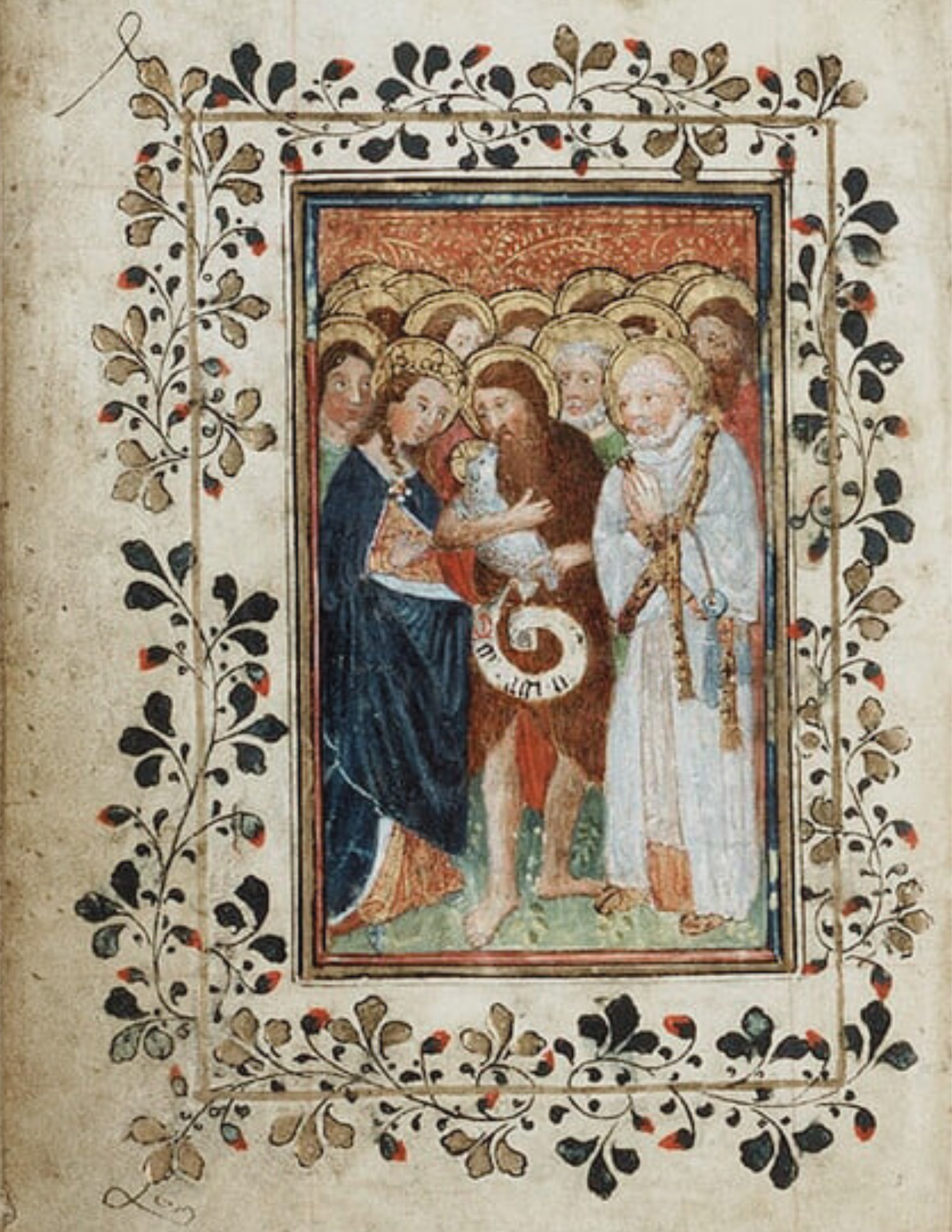
In the Middle Ages, paper saints (hand-colored woodcut images printed on paper) were used as devotional aids in homes and prayer books. Affordable and fragile, they helped ordinary believers keep the “cloud of witnesses” near in daily life. Their value was not in permanence, but in what they pointed to: faith practiced faithfully on holy ground.
This illuminated miniature depicts the presentation of Jesus in the temple, as recounted in Luke 2:22–38. Mary and Joseph bring the infant Christ to Jerusalem in obedience to the Law, where He is received by Simeon, the aged servant who had waited his lifetime to see the Messiah. The gathered figures suggest the presence of witnesses, perhaps including Anna the prophetess and the wider community of Israel awaiting redemption.
Rendered in the late fourteenth or early fifteenth century, this hand-colored work was likely produced in the Netherlands for use in a prayer book. Its small scale and careful detail reflect a form of devotion meant to be held, prayed over, and eventually worn thin.
Beautiful, imperfect, and perishable, paper saints remind us that holiness has always been formed slowly, in ordinary hands.